


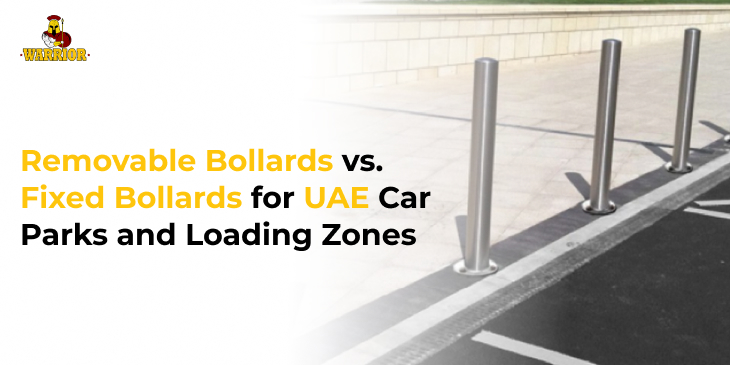
Every car park and loading zone in the UAE has the same quiet problem. Some spaces need to stay blocked most of the time, but not all of the time. A fire lane, a delivery bay, or a service route might only open a few times a week.
Pick the wrong barrier for that space and the problems add up fast. Racking gets clipped, access gets blocked, and staff start finding ways around the system. Fixed posts give you permanent protection, while removable bollards give you protection with a built-in exit plan. Both belong to a wider family of stainless steel bollards, crash-rated posts, and coated options.
The right choice usually has less to do with the bollard itself and more to do with how often that gap needs to open.
Key Takeaways
Fixed bollards work best where vehicles should never pass, while removable posts suit spaces that need occasional access, such as fire lanes, delivery bays, and service routes. Most UAE sites get the best results by mixing both types based on traffic flow, security needs, and how heat, sand, and humidity affect each location.
| Factor | Fixed Bollards | Removable Posts |
| Access | Permanent block | Opens when unlocked and lifted out |
| Impact strength | Generally higher due to deeper foundations | Moderate, depends on socket design |
| Best locations | Building corners, columns, pedestrian zones | Fire lanes, delivery bays, temporary closures |
| Maintenance | Low | Regular socket cleaning in sandy areas |
| Security role | Strong perimeter protection | Access control at lower threat levels |
| Cost drivers | Material and foundation depth | Sockets, locks, and lids add to the price |
Warrior WPS works with facility teams across the UAE to match barrier types to real traffic patterns, from busy basement car parks to open loading yards.
What Are the Different Types of Bollards?
Before comparing fixed and removable options, it helps to know the full lineup. Most parking bollards fall into one of a few groups, based on how they are mounted and what they are built to stop.
- Fixed (embedded) bollards: Set deep into concrete. They offer strong, permanent protection.
- Surface-mounted bollards: Bolted to the floor with a base plate. They are quicker to install but usually absorb less force.
- Removable posts: Sit in a ground socket and lift out after unlocking. The socket often closes with a flush lid.
- Retractable bollards: Sink down into the ground when access is needed. Retractable bollards come in manual versions and automatic versions powered by hydraulic or electro-mechanical systems.
- Crash-rated bollards: Engineered and tested to stop vehicles at set speeds. These are the true security bollards used around sensitive buildings.
- Material options: Galvanised steel, powder-coated steel, PVC-sleeved posts, and stainless steel bollards for areas where appearance and corrosion resistance matter.
Many UAE sites mix materials. A single car park might use bright sleeved steel posts in the basement for visibility and polished stainless units at the main entrance for a cleaner look.
The word “bollard” is widely believed to come from the heavy posts used to tie up ships along docks.
7 Ways Removable Bollards and Fixed Posts Differ on UAE Sites
Each type solves a different problem. These seven differences tend to shape the final decision for facility and logistics managers.
1. Access Flexibility
This is the biggest difference. Fixed posts never move, so the space they protect stays closed for good. Removable posts can be lifted out by an authorised person, opening a lane for a delivery truck, a fire tender, or a maintenance crew.
If a gap needs to open more than once a day, the lifting and locking can become a chore. Automatic retractable units often make more sense in those high-frequency spots.
2. Impact Resistance
Fixed bollards usually win on strength. Their deep concrete foundation spreads impact force into the ground. Removable posts rely on a socket, and that connection point is often the weaker link.
Crash performance is measured through recognised test methods. The ASTM F2656 crash test standard gives vehicle barriers a penetration rating, though it also notes that a rating does not guarantee the same result in every site condition.
A post that looks heavy is not automatically crash rated. Always ask for test documentation if the bollard is meant to stop a vehicle, not just guide one.
3. Security Level
For high-risk sites like government buildings, data centres, or critical infrastructure, tested security bollards are the norm. These are usually fixed or heavy-duty automatic models.
Removable posts are better suited to lower-risk access control. They keep casual traffic out of pedestrian zones and loading areas, but they are not the first choice for hostile vehicle protection.
4. Performance in UAE Heat, Sand, and Humidity
The UAE climate is tough on outdoor equipment. Summer surface temperatures run very high, coastal sites face salty humid air, and fine sand gets into everything.
- Heat can fade coatings and sleeves over time.
- Salt air speeds up corrosion, which is why many coastal projects specify stainless steel bollards as a marine-grade material.
- Sand is the biggest issue for removable posts. It fills sockets and can jam locks.
Choose sockets with tight-fitting lids and drainage holes. Lids keep sand out when the post is removed, and drainage stops water from pooling after cleaning or rare heavy rain.
5. Installation Work and Downtime
Fixed bollards need deeper excavation or core drilling, plus concrete curing time. Removable posts also need concrete work for the socket, but the posts themselves can be fitted later and swapped easily if damaged. Surface-mounted options are the fastest, though they suit lighter-duty jobs.
6. Maintenance Demands
Fixed posts need little more than regular inspection and occasional repainting. Removable posts need extra attention:
- Clean sockets to remove sand and debris
- Lubricate locks so they turn smoothly
- Check lids and hinges for wear
- Keep track of keys so the post can be moved when needed
7. Long-Term Cost
Upfront prices vary widely by material, size, and rating, so quotes should be compared line by line. Removable systems add the cost of sockets and locks. Retractable bollards cost more again, especially automatic models that need power, controls, and servicing.
Over time, the cheapest option is the one that fits the job. A fixed post in a lane that needs regular access will cause workarounds, and a removable post in a high-impact zone may need frequent replacement.
Need help deciding which posts belong in which bays? Our team can review your site layout and recommend a practical mix of fixed and removable protection.
Choosing the Right Mix for Car Parks and Loading Zones
Most sites do not need to choose one type only. The smartest layouts match each bollard to the traffic around it.
Car Parks
In car parks, parking bollards protect columns, pay stations, lift lobbies, and pedestrian walkways. Fixed posts suit these permanent hazards. Removable posts work well across fire lanes and reserved bays that open only occasionally.
Pedestrian safety goes beyond the parking deck. Hospitals and care facilities, for example, often guide people from the car park to the entrance using clear routes and PVC handrails for added support.
Loading Zones
Loading zones see heavy vehicles, forklifts, and tight turning angles. Fixed posts protect dock doors, building corners, and utility equipment. Removable posts help when a bay needs to open for oversized deliveries or temporary storage.
Inside the warehouse, bollards often work alongside wall guards that absorb impact from trolleys and pallet jacks.
| Location | Suggested Type | Reason |
| Building corners and columns | Fixed | Constant impact risk |
| Fire lanes | Removable | Must open for emergencies |
| Delivery bays | Removable or retractable | Access needed on a schedule |
| Main vehicle entrances | Fixed or crash-rated | Security and perimeter control |
| Pedestrian walkways | Fixed | Permanent separation from traffic |
Fire lane access rules can vary by emirate and building type. Check with the relevant civil defence authority before placing any barrier across an emergency route.
How Do I Install a Removable Bollard?
Installation is usually handled by a trained contractor, but understanding the process helps you plan downtime and budgets.
- Survey the site. Check for underground cables, pipes, and drainage. Confirm the slab can take a socket.
- Mark the positions. Space posts close enough to stop cars, while leaving room for pedestrians and wheelchairs.
- Excavate or core drill. Create a hole deep enough for the socket and its concrete surround.
- Set the socket. Place it level with the finished floor so the lid sits flush and does not create a trip hazard.
- Pour and cure the concrete. Allow full curing time before loading the socket.
- Fit and test the post. Insert the bollard, lock it, and check that it lifts out smoothly.
- Train your team. Show staff how to remove, store, and replace the post safely.
Keep a simple key register. Lost keys are one of the most common reasons removable posts stay locked in place when they should not.
A post that jams across a fire lane can slow emergency response. Regular socket checks keep your access plan working when it counts most.
Ready to plan protection for your car park or loading bay? Request a site survey and quote from our safety specialists today.
Conclusion
Fixed and removable posts are partners, not rivals. Fixed units handle constant hazards and perimeter protection. Removable bollards handle the spaces that must stay flexible, like fire lanes and delivery bays. The best UAE layouts use both, chosen for local heat, sand, traffic flow, and security needs.
Warrior WPS supplies both fixed and removable options built for demanding industrial and commercial sites.
Your car park should not need a guessing game to stay safe. Talk to Warrior WPS and put every post exactly where it earns its place.
Frequently Asked Questions
What Are Removable Bollards?
They are posts that sit in a ground socket and can be unlocked and lifted out to allow vehicle access. When removed, a lid usually covers the socket to keep the surface level.
How Long Do Bollards Last in UAE Conditions?
Lifespan depends on material, coating, and exposure. Stainless and well-coated steel posts tend to last longer, especially with regular cleaning and inspection.
Can Bollards Be Installed on Asphalt Surfaces?
Yes, but most installers pour a concrete pad or footing first. Asphalt alone is usually too soft to hold a socket or fixed post securely.
What Height Should Car Park Bollards Be?
Many car park posts sit close to one metre tall, but the right height depends on visibility, vehicle types, and local guidance. Taller posts with reflective bands are easier for drivers to spot.
Do Security Bollards Need Special Foundations?
Yes, crash-rated security bollards usually need deeper, engineered foundations. The foundation design should follow the manufacturer’s tested specifications.