

A truck moving at highway speed carries enough force to flatten a standard gate in seconds. For Saudi Arabia’s oil, gas, and petrochemical facilities, that risk is not a hypothetical. It shapes how every entrance, fence line, and access road gets designed.
This is why HCIS-compliant bollards have become a core part of perimeter security across the Kingdom. These are not ordinary posts. They are engineered barriers built to stop a vehicle cold, and tested to prove it.
Facility teams that source crash-rated HVM bollard systems the right way protect people, assets, and production uptime all at once. The gap between a bollard that looks tough and one that actually stops a truck comes down to a few numbers most buyers never check.
Key Takeaways
HCIS-compliant bollards are crash-rated barriers that meet the security rules set by Saudi Arabia’s High Commission for Industrial Security, and industrial sites choose them by matching the bollard’s crash rating, size, and placement to the vehicle threat at each entry point. In simple terms, the higher the risk, the stronger the rating you need. The right choice depends on how fast a vehicle could approach, how heavy it might be, and how much open ground sits behind the barrier.
| What to check | Why it matters |
| Crash rating (K or M) | Sets the vehicle speed and weight the bollard can stop |
| Penetration rating (P) | Shows how far a truck travels past the barrier after impact |
| Full system testing | The rating covers the post, foundation, and spacing together |
| Size and spacing | Gaps that are too wide let vehicles slip through |
| Material and coating | Coastal air corrodes steel faster and shortens service life |
| Documentation | HCIS review needs certificates that match the installed product |
Warrior WPS works with facility teams across the region to match HCIS-ready barriers to real site risk, so the specification is correct before anything gets poured into the ground.
What HCIS Compliance Means for Industrial Bollards
HCIS stands for the High Commission for Industrial Security. It operates under Saudi Arabia’s Ministry of Interior and sets the security, safety, and fire protection rules for industrial facilities and critical infrastructure across the Kingdom. These rules are known as the HCIS Directives, and following them is a legal requirement for sites that fall under their scope.
For perimeter protection, this affects how a site handles vehicle access. Fences, gates, road blockers, and safety bollards all play a role in keeping an unauthorized vehicle away from sensitive areas. Bollards are the piece that holds the line at gates, along fence lines, and around control rooms, tank farms, and pipelines.
A bollard earns the “HCIS-compliant” label when it meets the standards a site’s security plan calls for and carries the crash-test evidence to back it up. A generic post that has never been tested does not qualify, no matter how heavy it looks.
HCIS Directives are legally binding under the laws of the Kingdom, and compliance is a condition of operating a covered facility. Inspectors review sites for it, so barrier choices are a matter of record, not preference.
Which Saudi Facilities Require HCIS-Compliant Bollards?
HCIS rules focus on facilities where a security failure could cause serious harm to people, the economy, or national infrastructure. Sites that commonly fall under these requirements include:
- Oil production, processing, and storage facilities
- Gas plants and refineries
- Petrochemical and chemical plants
- Power generation stations and utilities
- Ports, terminals, and pipeline infrastructure
- Other designated critical infrastructure
If a site handles hazardous materials or supports essential services, it very likely needs a perimeter plan that includes crash-rated barriers. The exact rating and layout depend on a site-specific risk assessment carried out with HCIS guidance.
Crash Ratings Explained: What K4, K8, and K12 Mean
A crash rating tells you the one thing that matters most: how much of a moving vehicle a barrier can actually stop. This is where crash-rated bollards separate themselves from decorative posts. The rating comes from a real impact test, not a spec sheet estimate.
What Are the Different K Ratings for Bollards?
The K rating system comes from a United States Department of State standard, and it is still widely referenced in security specifications. Every K rating tests the same vehicle, a 6,800 kg (15,000 lb) medium-duty truck, at a different speed:
| Rating | Vehicle speed | Common use |
| K4 | About 48 km/h (30 mph) | Lower-risk entry points and checkpoints |
| K8 | About 64 km/h (40 mph) | Medium-risk perimeters |
| K12 | About 80 km/h (50 mph) | High-security and critical infrastructure |
So k4 rated bollards are built to stop that truck at roughly 30 mph, while K12 units handle the same truck at highway speed. Because impact energy climbs sharply as speed rises, a K12 barrier absorbs far more force than a K4 unit, not just a little more.
Newer specifications often use ASTM M ratings instead. M30, M40, and M50 line up closely with K4, K8, and K12, and they come from the ASTM F2656 test method, the standard that now guides crash testing for vehicle security barriers worldwide. You will often see both systems referenced side by side, which is why buyers should confirm which one a quote is using.
A crash rating applies to the whole tested system, not the post alone. The bollard, its foundation, the spacing, and the way it is anchored were all tested together. Change any of those on site, and the rating may no longer hold.
Alongside the K or M number, look for the penetration rating, written as P1, P2, or P3. This shows how far the vehicle traveled past the barrier line after impact. P1 means less than about a meter, which is what you want near people and control rooms. P3 means the vehicle was stopped but pushed well past the line.
The energy a vehicle carries rises with the square of its speed, so a truck at 50 mph hits with far more than double the force of the same truck at 30 mph. That single detail is why speed drives the whole rating system.
Two bollards can share the same K12 or M50 speed rating and still perform very differently. The penetration rating is what tells you how close the truck gets to what you are protecting, so read both numbers, not just the headline one.
Standard Bollard Sizes, Spacing, and Materials
Once the rating is set, the physical build decides how the barrier fits into your site. Getting the sizing and layout right is what turns a strong rating into real protection on the ground.
What Are Standard Bollard Sizes?
Bollard sizes vary by purpose, so treat these as general ranges rather than fixed rules:
- Diameter: Core diameters commonly run from about 4 to 6 inches for standard units, while heavy-duty security posts often use 8 inches or more.
- Above-ground height: Many security bollards sit around 36 to 42 inches above the finished surface, high enough to catch a vehicle’s frame.
- Spacing: Center-to-center spacing is often kept in the range of roughly 1.0 to 1.5 meters, close enough to block a passenger vehicle while still allowing people to pass.
- Foundation: Crash-rated bollards usually need a deep, engineered foundation, since much of the stopping power lives below the surface.
The exact figures always come from the tested configuration and the site’s soil and layout. A structural review should confirm embedment depth and spacing for the specific product.
Plan your setback before you plan your spacing. The open distance between the barrier and the thing you are protecting decides how much penetration you can safely allow, and it often matters more than the raw speed rating.
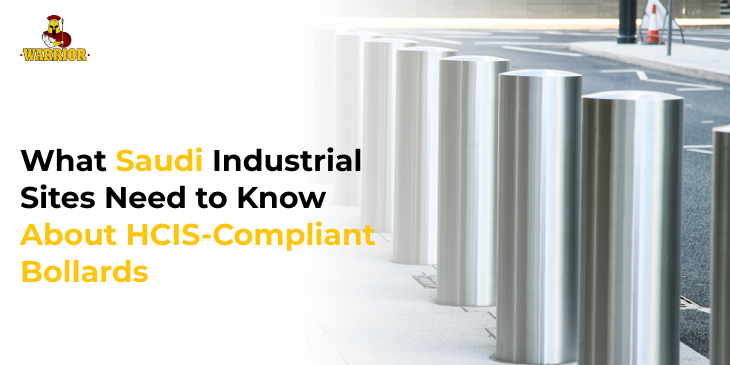
Material choice is the next big decision. Coated carbon steel filled with concrete is a common, cost-effective build for crash bollards. Well-chosen safety bollards hold their rating for years when the material matches the site. For locations near the coast, corrosion resistance moves up the priority list, which is where stainless steel bollard options earn their place. The same salt-air challenge that affects corrosion and lifecycle in coastal cities for other fittings applies just as strongly to perimeter hardware.
Buyers weighing large orders also think about lifecycle cost, not just the sticker price. The same logic that guides cost-effective material choices on big commercial projects applies here: the cheapest unit today can cost more over ten years once maintenance and replacement are counted.
Saudi coastal industrial hubs like Jubail and Yanbu sit in a harsh, salty climate. Standard steel that performs well inland can corrode faster there, so match the coating or grade to the location, not to a generic spec.
What Saudi Industrial Sites Need to Know Before Choosing HCIS-Compliant Bollards
When it comes time to specify HCIS-compliant bollards, a few checks separate a smooth approval from a costly redo. For example, k4 rated bollards may suit a lower-risk checkpoint, while a busy main gate could call for K8 or K12 protection. Work through these before you commit to a design:
- Match the rating to the real threat. Base the K or M rating on how fast and how heavy a vehicle could realistically be at that access point, using the site risk assessment.
- Read the penetration rating too. A high-speed rating with a poor penetration result may still let a truck reach what you are protecting.
- Confirm the full system was tested. The certificate should cover the post, foundation, and spacing as an installed unit, not the bollard by itself.
- Get the spacing right. Gaps that are even slightly too wide can let a vehicle strike at an angle and slip between posts.
- Account for setback. Leave enough distance behind the barrier so that any allowed penetration still stops short of people and equipment.
- Choose materials for the climate. Pick coatings or grades that stand up to heat, dust, and, for coastal sites, salt air.
- Verify foundation and soil needs. Soil type changes how deep and how strong the footing must be, so involve a structural engineer early.
- Keep the paperwork in order. Store crash-test certificates that match the exact product installed, since HCIS review depends on documentation that lines up with reality.
Ask for the full crash-test report, not just a rating label, before you buy. A single line on a brochure is not the same as a certificate that names the vehicle, speed, and penetration result.
For sites weighing K4 through K12 options, a short consultation with barrier specialists can turn a vague threat picture into a clear, defensible specification.
Where Procurement Teams Go Wrong
Even careful buyers hit the same avoidable mistakes. Knowing them ahead of time saves money and rework.
The most common error is treating crash bollards as an off-the-shelf commodity and buying on price alone. A post rated for one configuration can lose its rating the moment the spacing or foundation changes on site. Another frequent slip is ignoring the penetration number and assuming that a strong speed rating tells the whole story. Teams also underestimate coastal corrosion, then face early replacement costs that erase any upfront savings.
Finally, some sites install strong barriers but keep weak records. If the certificates do not match the installed product, an inspection can flag the whole line even when the hardware itself is sound.
Bring a specialist into the conversation before the design is locked, and you avoid the expensive habit of solving perimeter problems twice.
Conclusion
Choosing HCIS-compliant bollards is a decision about numbers and evidence, not appearances. The rating tells you what a barrier can stop, the penetration figure tells you how close a threat gets, and the size, spacing, and materials decide how well that protection lasts in Saudi Arabia’s demanding climate. Get those elements right, back them with proper documentation, and your perimeter stands up to both a real vehicle and an HCIS inspection.
The good news is that none of this has to be guesswork. The team at Warrior WPS helps industrial sites specify, source, and install crash-rated barriers that meet the rules and fit the site, so you protect what matters without overspending. When you are ready to lock in a compliant perimeter, Warrior WPS is ready to help you build it right the first time.
Frequently Asked Questions
Do HCIS-compliant bollards need certification from a specific test lab?
The bollards must carry valid crash-test certification to a recognized standard such as ASTM F2656, and the documentation should match the exact product and configuration installed on site.
Can existing bollards be upgraded to meet HCIS requirements?
In most cases, the safer path is replacing untested posts with crash-rated units, since a rating depends on the whole tested system and cannot be added to hardware that was never impact-tested.
How long does bollard installation take at an industrial site?
Timelines vary with the number of units, foundation depth, and soil conditions, so a site survey is the best way to get a realistic schedule rather than a generic estimate.
Are removable or automatic bollards allowed at HCIS-covered sites?
Yes, removable and automatic rising bollards are widely used at gates and checkpoints, as long as the specific model carries the crash rating the site’s security plan requires.
Do HCIS requirements differ for coastal facilities?
The security ratings stay the same, but coastal sites usually need corrosion-resistant materials or coatings so the barriers hold their strength and appearance over their full service life.