


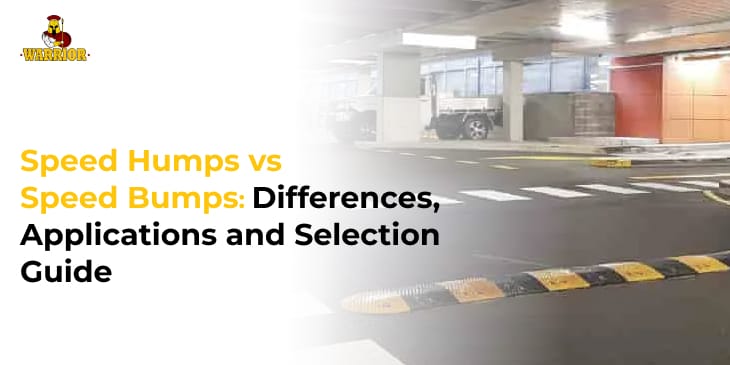
Every parking lot, loading bay, and residential street shares the same problem. Cars move too fast in places where people walk. Two devices show up again and again to fix it, and they look almost identical from the driver’s seat.
Most people use the two names as if they mean the same thing. They do not. Speed humps and speed bumps are built to different shapes, for different speeds, and for very different places.
Picking the wrong one can slow the wrong traffic, jar vehicles, or frustrate everyone who drives through. Choosing the right product, like a set of durable rubber speed humps, starts with knowing what sets the two apart. A few centimetres of height can change how a whole road behaves.
Key Takeaways
The main difference between speed humps and speed bumps comes down to size and target speed. Speed bumps are taller and narrow, so they force cars almost to a stop, which suits parking lots and private driveways. Speed humps are lower and much wider, so they slow cars to a gentle roll without a hard jolt, which suits streets and busy aisles. The right choice depends on the speed you want, the kind of traffic you have, and the surface you are working with.
| Question | Quick Answer |
| What is the core difference? | Bumps are tall and narrow. Humps are low and wide. |
| Which slows cars more? | Speed bumps, down to a near stop. |
| Which is gentler on cars? | Speed humps, with a smooth rocking feel. |
| Best place for bumps? | Parking lots, driveways, and private roads. |
| Best place for humps? | Streets, school zones, connector roads, long aisles. |
| Common material for both? | Rubber, plastic, asphalt, or concrete. |
| Which is easier to install and move? | Modular rubber units, either type. |
Warrior WPS builds rubber traffic-calming and impact-protection products made for the heat, dust, and heavy use of sites across Oman and the wider Gulf.
What Speed Humps and Speed Bumps Really Are
Both devices belong to a family called traffic-calming measures. These are physical features built into a road or surface that make drivers slow down on their own. A sign can be missed or ignored. A raised section of road cannot. When a driver feels the front tyres start to climb, the foot comes off the accelerator without a second thought.
Both work the same basic way. A raised shape sits across the path of travel. When a vehicle rolls over it too fast, the ride gets rough. Drivers learn quickly and slow down before they reach it. The size and shape of that raised section decide how hard the lesson feels.
The general rule is simple. Taller and narrower means a harder jolt at a lower speed. Lower and wider means a softer slowdown at a slightly higher speed.
What Are Speed Humps?
A speed hump is a low, rounded rise that stretches across the road. The part a car drives over is wide, often around three to four metres from front edge to back edge. Because the slope is long and gentle, a car passing at the right speed feels a smooth rocking motion instead of a sharp bang.
Speed humps are built to hold traffic at a moderate pace, often somewhere near 25 to 30 kilometres per hour. That makes them a good match for residential streets, school zones, hospital grounds, and the long driving aisles of large car parks. They slow cars without bringing them to a crawl, so traffic keeps flowing.
Speed humps go by a few other names in traffic-engineering documents. You may see them written as road humps or undulations. The idea behind each name is the same, which is a long, gentle rise that calms a steady flow of traffic.
What Are Speed Bumps?
A speed bump is the aggressive cousin. It is taller and much narrower, so the raised section sits under a tyre for only a short moment. That short, steep shape delivers a firm jolt, even at low speed. Drivers respond by slowing almost to a stop, often to around 5 to 15 kilometres per hour.
That sharp action makes speed bumps the right tool for tight, shared spaces. Think of a supermarket car park, a loading bay, a gated community entrance, or a private driveway. In these places, cars and people mix closely, and you want vehicles crawling, not cruising.
What is another name for speed bumps? In many regions, including much of the Gulf and South Asia, a speed bump is called a “speed breaker.” It also carries the old nickname “sleeping policeman,” along with “road bump” in casual use. The names change, but the job stays the same.
The term “sleeping policeman” has been used for decades in many English-speaking countries. The idea is that the bump does the same job as a traffic officer, only it never takes a break.
Speed Humps vs Speed Bumps: 7 Key Differences
What are the differences between speed humps and speed bumps? In short, the two devices differ in height, width, target speed, ride feel, best location, material, and cost. Each of these points changes how the device performs and where it belongs. Here is the full speed humps vs speed bumps breakdown, one factor at a time.
- Height. Speed bumps tend to sit taller, which is part of what makes them so firm. Speed humps are usually lower and more rounded, giving a softer contact with the tyre.
- Width across the road. This is the biggest visible difference. Speed bumps are narrow, often well under half a metre in the direction of travel. Speed humps are wide, frequently three to four metres, so the climb and drop are spread out.
- Target speed. Speed bumps are built to slow cars to a near stop, often around 5 to 15 kilometres per hour. Speed humps hold a steadier, higher pace, often close to 25 to 30 kilometres per hour.
- Ride feel. Drive a bump too fast and you get a hard, jarring hit. A hump at the right speed gives a smooth, rolling lift and dip. That difference in feel is exactly why each one suits a different setting.
- Best location. Bumps belong in slow, tight, private spaces like car parks, driveways, and loading zones. Humps belong on through-roads, school streets, and long aisles where traffic needs to keep moving at a safe speed.
- Effect on larger vehicles. Buses, trucks, and emergency vehicles handle wide humps far more comfortably than sharp bumps. A narrow bump can slow an ambulance more than you want, while a hump lets it pass at a reasonable speed.
- Material and installation. Both come in rubber, plastic, asphalt, or concrete. Rubber and plastic units are usually modular. They bolt down in sections, which makes them quick to fit and easy to move or replace later.
Here is the same comparison in a table you can scan at a glance.
| Feature | Speed Bump | Speed Hump |
| Height | Taller | Lower and rounded |
| Width across road | Narrow | Wide (often 3 to 4 m) |
| Target speed | ~5 to 15 km/h | ~25 to 30 km/h |
| Ride feel | Sharp jolt | Gentle rocking |
| Best for | Car parks, driveways, loading bays | Streets, school zones, long aisles |
| Large vehicles | Slowed sharply | Pass more smoothly |
| Common install | Modular, bolt-down | Modular or paved in |
Picking the right one is about the result you want. If people and cars are packed into a small area, a bump keeps everyone safe by forcing a crawl. If you have a longer road where traffic should stay steady but calm, a hump does the job without the harsh stop-start. Facility managers who study the payoff of adding speed humps in high-traffic zones often find that steadier speeds also mean fewer near-misses and less wear on the site.
Speed humps are so often mistaken for bumps that many road signs simply say “bump,” even where the device on the ground is a proper hump. The public tends to use one word for both.
What Is a Type 2 Speed Hump? Types Explained
Once you start shopping for products, you will run into type labels, and this is where buyers get confused. What is a type 2 speed hump? It is a category that comes from a widely referenced Australian Standard for parking facilities, AS2890.1. That standard sorts car-park humps into two main types based on where they are used and how much they slow traffic.
Many suppliers across the world, including those serving the Gulf, describe their products using these type labels because the standard is clear and easy to follow. Local projects in the UAE and Oman may also follow municipal rules or other international standards, so it is always worth checking the requirement for your specific site.
Here is the plain-language version of each type.
- Type 1 speed hump. This one suits circulating roadways and long aisles, the kind you find in large outdoor car parks or school grounds. It is designed to bring vehicles from above 30 kilometres per hour down to a safer speed below 25 kilometres per hour. These are usually spaced further apart, often with a gap of around 30 metres between units.
- Type 2 speed hump. This one is meant for tighter, slower areas, such as covered car parks and multi-storey car parks, where vehicles already move below about 30 kilometres per hour but need an extra nudge to stay slow near people. A Type 2 hump is flat on top, not rounded, with a ramp on each side. Under the standard, these humps are usually spaced closer together, often with a minimum gap near 10 metres.
The flat-top shape matters. A Type 2 hump is designed with a level middle section and defined ramp angles rather than a simple round dome. Standards of this kind also call for bright, alternating colour stripes so the hump stands out. That mix of shape and marking helps protect a range of vehicles, from low sports cars to loaded delivery vans.
If a supplier cannot tell you which type a product matches or what standard it follows, treat that as a warning sign. Type labels exist to keep drivers and vehicles safe, and a good manufacturer will know exactly where each product fits.
Other Traffic-Calming Devices Worth Knowing
Humps and bumps are the two most common tools, but they are part of a bigger toolbox. Knowing the full set helps you avoid forcing one device to do a job another does better.
- Speed cushions. These look like humps with gaps cut into them. The gaps let wide vehicles, such as fire trucks and buses, straddle the device and pass without a jolt, while narrower cars still get slowed. They are handy on emergency routes.
- Speed tables. A speed table is a long, flat-topped hump, often wide enough that a pedestrian crossing can sit right on top. Cars slow down, and people cross at a slightly raised level that keeps them more visible.
- Rumble strips. These are shallow, closely spaced ridges that make a loud sound and a light vibration. They warn drivers to pay attention rather than physically slowing them much. They work well ahead of a junction or a sharp change in the road.
- Corner and wall protection. Slowing traffic is only half the safety picture. In tight car parks and loading bays, vehicles still clip corners and scrape walls. Fitting impact-resistant wall guards on exposed edges keeps repair bills down and keeps your site looking cared for.
Each of these has a place. The trick is to match the device to the behaviour you want. If you want cars to slow but big trucks to keep moving, a cushion beats a hump. If you want to protect a crossing, a table beats a plain bump.
Warrior WPS can supply speed humps, corner guards, wall guards, and matching accessories as one coordinated set, so your whole site follows a single safety plan instead of a patchwork of parts.
How to Choose the Right One for Your Site
For property managers, facility directors, and business owners, the choice is a practical one. You want the safest result at a fair cost, with the least disruption. Work through these questions and the answer usually becomes clear.
- What speed do you need? If you want cars nearly stopped, choose a bump. If you want a steady, calm flow, choose a hump.
- Who uses the space? Heavy pedestrian mixing, like a shopfront car park, points to bumps. A through-road or long aisle points to humps.
- What vehicles pass through? Sites with buses, trucks, or emergency access lean toward humps or cushions, which treat larger vehicles more kindly.
- What is the surface like? Smooth, solid asphalt or concrete holds bolt-down rubber units well. Loose gravel is a poor base, because bolts work loose over time.
- How permanent is the need? Rubber and plastic units can be unbolted and moved, which suits car parks that get re-planned. Paved-in humps are fixed for the long term.
- What is the budget over time? A cheap product that cracks and fades in the sun costs more in the long run. Durable units that hold up to heat and heavy loads pay for themselves.
A simple example helps. A gated residential compound with a long internal road and regular delivery vans would do well with wide speed humps. They calm traffic without punishing the vans. A small, busy retail car park with people walking between rows would do better with speed bumps, forcing a crawl in the tight space. Same goal, different tool.
Studies of traffic-calming projects have long shown that lowering vehicle speed reduces both the chance of a crash and the severity of one. Even a small drop in speed can make a real difference for a pedestrian.
Why Rubber Speed Humps Suit Commercial Sites in the Gulf
For commercial and industrial sites in Oman and the wider Gulf, material choice is a big deal. The climate is hard on everything. Strong sun, high heat, and fine dust wear down cheap products fast. Poured asphalt or concrete humps also mean closing part of your site while they cure, which costs you time and access.
Rubber speed humps solve much of this. They arrive as modular sections that bolt straight onto a solid surface. A crew can fit them in hours, not days, and traffic can return quickly. If the site layout changes, the sections come up and move to a new spot with no wasted material.
Good rubber units are built to take repeated hits from heavy vehicles without cracking. Reflective inserts and bright colour bands keep them visible at night and in low light, which is important in busy loading yards. When one section wears out, you replace that one piece rather than tearing up the whole run.
Here is a quick side-by-side of the common material options.
| Material | Strengths | Watchouts |
| Rubber | Fast to fit, movable, tough, and with a good grip | Needs a solid base to bolt into |
| Plastic | Light and low cost | Can fade or crack under strong sun |
| Asphalt | Blends into the road | Slow to install, hard to remove |
| Concrete | Very long-lasting | Fixed in place, longer to build |
For most private commercial sites, modular rubber gives the best balance of speed, strength, and flexibility. It handles the heat, stands up to trucks, and keeps your options open if plans change.
Ready to slow traffic and protect your site the right way? Contact Warrior WPS for rubber speed humps and impact guards matched to your surface, your vehicles, and your local requirements.
Conclusion
The gap between the two devices is small in size but large in effect. Speed bumps are tall and narrow, so they stop traffic in tight, shared spaces. Speed humps are low and wide, so they calm a steady flow on streets and aisles without the harsh jolt. Add in the type labels, the other tools like cushions and tables, and the right material for a hot, dusty climate, and the picture becomes clear.
Getting the choice right means safer people, smoother traffic, and less damage to both vehicles and your property.
When it comes time to fit reliable speed humps and matching protection built for Gulf conditions, partner with Warrior WPS for products that slow cars down and hold up for the long haul.
Frequently Asked Questions
Do speed humps or speed bumps damage vehicles?
Used at the right speed, neither should harm a well-maintained vehicle. Damage usually happens when a driver hits a device too fast or when a poorly shaped, non-standard product is installed on the wrong road.
How far apart should speed humps be spaced?
Spacing depends on the type and the target speed, but they are placed in a series so drivers cannot speed up between them. Product standards often suggest gaps in the range of around 10 to 30 metres, so check the rule for your site.
Are rubber speed humps better than concrete ones?
Rubber humps install faster, can be moved or replaced in sections, and handle heat and impact well, which suits changing commercial sites. Concrete lasts a very long time but is fixed in place and slower to build.
Can emergency vehicles pass over speed humps easily?
Wide speed humps let ambulances and fire trucks pass at a reasonable speed, which is why they are preferred over sharp bumps on emergency routes. Speed cushions with cut-out gaps are an even better fit where large vehicles need clear passage.
Do speed humps need special road markings or signs?
Yes, bright colour bands and warning signs help drivers see a hump in time, especially at night or in covered car parks. Clear markings also lower the risk of a driver hitting it unprepared and losing control.